
There’s been a lot of conversation in the RV industry about new RV production, dealer inventories, interest rates, and what all of that means for manufacturers.
But from where I stand as a mobile RV technician, there’s another side of the story.
There are already a lot of RVs sitting in driveways, campgrounds, storage lots, and RV parks across the country. Those RVs still need to be maintained. They still need to be repaired. They still get bought and sold. And their owners still need help understanding how everything works.
The RV Industry Is More Than New RV Sales
When people hear that RV manufacturing is slowing down, it’s easy to assume the entire RV industry must be slowing down with it. But a manufacturer depends heavily on selling new RVs. An RV service business works primarily with RVs that have already been purchased.
Travel trailers, fifth wheels, Class A motorhomes, Class B vans and Class C motorhomes don’t disappear because fewer new units roll off an assembly line.
Every year an RV remains on the road is another year its components continue to age. Sealants deteriorate. Batteries age. Electrical connections can loosen or corrode. Water pumps quit. Air conditioners need service. Slides and leveling systems develop problems. Plumbing fittings leak. Holding tanks need attention.
Sometimes the problem is complicated. Sometimes the smallest part causes the biggest headache.
Keeping an Existing RV Longer Changes the Maintenance Equation
If an RV owner decides not to trade every few years, maintaining the RV they already own becomes increasingly important.
A little roof-sealant problem that gets ignored can eventually become a much larger water-intrusion problem. A battery problem can look like a converter problem. A loose electrical connection can cause an intermittent issue that seems impossible to reproduce.
And sometimes a component gets blamed simply because it’s the most obvious suspect.
That’s why I’m a big believer in diagnosing before replacing parts. Throwing parts at an RV until the problem disappears can get expensive very quickly. A good RV repair starts with figuring out what actually failed.
Older RVs Aren’t Necessarily Bad RVs
I work on enough RVs to know that age by itself doesn’t tell the whole story. I’d rather see an older RV that has been maintained properly than a newer RV that has been neglected.
How was the roof maintained? Were leaks addressed quickly? Have the wheel bearings and brakes been serviced? What condition are the tires in? Is the electrical system functioning properly? Have the appliances been maintained? Are the slides and leveling systems operating correctly?
Those things matter. The goal of preventive RV maintenance isn’t to make an older RV new again. It’s to identify developing problems before they become much more expensive ones.
The Used-RV Market Makes Inspections Important Too
When someone decides that a brand-new RV isn’t right for them, a used RV can be an attractive alternative. There are some very nice used RVs out there.
There are also RVs that look fantastic from the campground side and have a completely different story once you start looking closely.
That’s where an independent RV inspection can help. The purpose isn’t to find reasons not to buy an RV. It’s to give the buyer information about its condition so they can make their own decision.
A thorough inspection can look at areas such as the roof, moisture concerns, electrical systems, plumbing, LP-related components, appliances, slides, leveling, awnings, undercarriage and safety equipment.
RV Owner Education Is Part of the Picture
Here’s the thing…modern RVs have a surprising number of systems packed into a relatively small space.
You can have 120-volt AC power, 12-volt DC power, batteries, charging systems, solar, converters, inverters, propane, freshwater plumbing, wastewater systems, slides, leveling, air conditioning, furnaces, water heaters and electronic controls.
Then somebody hands the new owner a bag of manuals and says, “Enjoy your camper.”
That can be overwhelming.
You don’t need to know how to repair everything yourself. But understanding the basics can save a lot of frustration. Knowing what your converter does, where your water-heater bypass valves are, what your battery disconnect actually controls, and what an early roof-sealant problem looks like can make RV ownership easier.
Mobile RV Service Fits the Way People Actually Use RVs
An RV that needs service isn’t always easy to take somewhere. You may be living in it. You may already be set up at a campground. The slides are out, the leveling system is down, and water, sewer and electrical are connected.
Or the problem itself may make the RV difficult to move.
That’s where a mobile RV technician can make sense. We come to the RV and can often see the problem in the environment where the RV is actually being used.
Some repairs absolutely belong at a dealership or specialized repair facility. But many diagnostics, maintenance items and repairs can be handled where the RV sits.
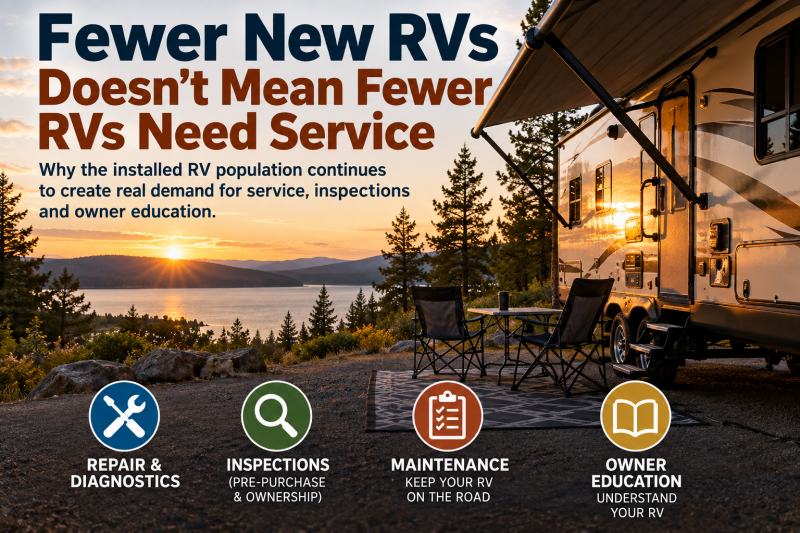
Four Needs That Continue After the RV Is Sold
Repair & Diagnostics
Finding the actual cause of electrical, plumbing, HVAC, slide, leveling and appliance problems.
RV Inspection
Helping buyers and owners better understand the condition of an RV.
RV Maintenance
Addressing developing problems and maintaining systems as the RV ages.
RV Owner Education
Teaching owners how their RV works, what to watch for and when to call for help.
What This Means for RV Owners
The RV industry will continue changing. Manufacturers will adjust production. Dealers will adjust inventories. Financing conditions will change. New technology will continue showing up.
But the RVs already traveling America’s highways aren’t going anywhere overnight.
They’ll continue getting older. They’ll continue changing owners. And they’ll continue needing maintenance, inspection, diagnosis, repair and education.
For us at MilTech RV Repair & Inspection, that’s where the focus remains.
Diagnose it. Explain it. Repair it. Help the owner understand it.
Because as long as people are camping, those RVs are going to need somebody to help keep them working.
Need Help With the RV You Already Own?
MilTech RV provides mobile RV repair, diagnostics, inspections, maintenance and RV owner education.
Visit MilTech RV RV InspectionsWhat are you doing differently to keep your current RV on the road longer?